Looking for GD&T true position CNC machining guidance? You are in the right place. This guide answers the key questions for engineers.
What True Position Controls, GD&T true position CNC machining
True Position (symbol: ⌖) defines a zone within which the center axis of a hole (or center plane of a slot) must fall. Unlike a coordinate tolerance (±X in X, ±X in Y), True Position uses a circular tolerance zone, which is actually more permissive and more logical for most hole applications.
The Feature Control Frame, GD&T true position CNC machining
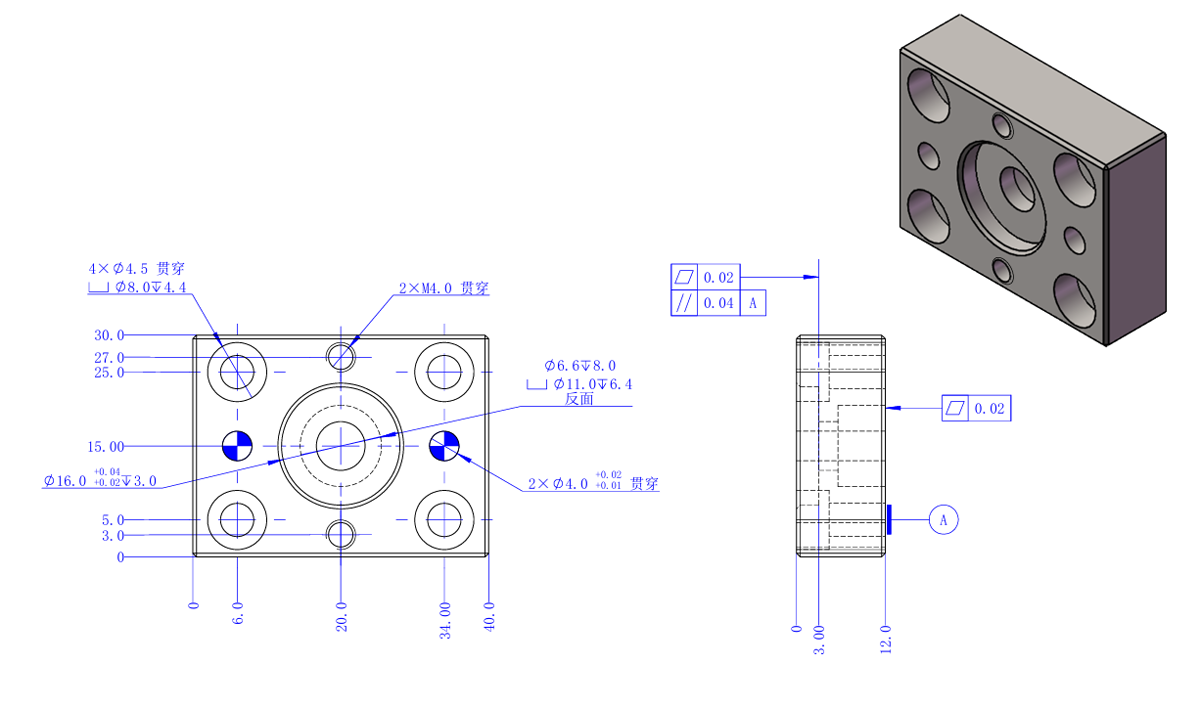
A True Position callout looks like this inside a rectangular frame: ⌖ | ⌀0.2 | A | B | C. Reading left to right: the True Position symbol, the diameter of the tolerance zone (0.2mm), and the datums the position is measured from (A, B, C). Datum A is typically the primary flat face, B and C are edges or features that establish X and Y origin.
Circular Zone vs Coordinate Tolerance, GD&T true position CNC machining
A coordinate tolerance of ±0.1mm in X and ±0.1mm in Y creates a square zone. The maximum deviation allowed in the corner of that square is 0.141mm, 41% more than intended. A True Position zone of ⌀0.2mm is a circle with diameter 0.2mm, the maximum deviation is always exactly 0.1mm from the true center, regardless of direction. This is more consistent and more permissive on average for a given "effective tolerance."
Virtual Condition and Bonus Tolerance, GD&T true position CNC machining
When True Position is applied at Maximum Material Condition (MMC), noted as ⌀0.2 M, the tolerance zone expands as the hole grows larger (further from MMC). This "bonus tolerance" is a powerful concept: a hole allowed to be ⌀10.0mm ± 0.05mm with True Position ⌀0.2 M can have a positional deviation of up to ⌀0.25mm when the hole is at its maximum size (⌀10.05mm). This accounts for the looser assembly clearance when the hole is bigger.
How Machinists and CMMs Measure True Position, GD&T true position CNC machining
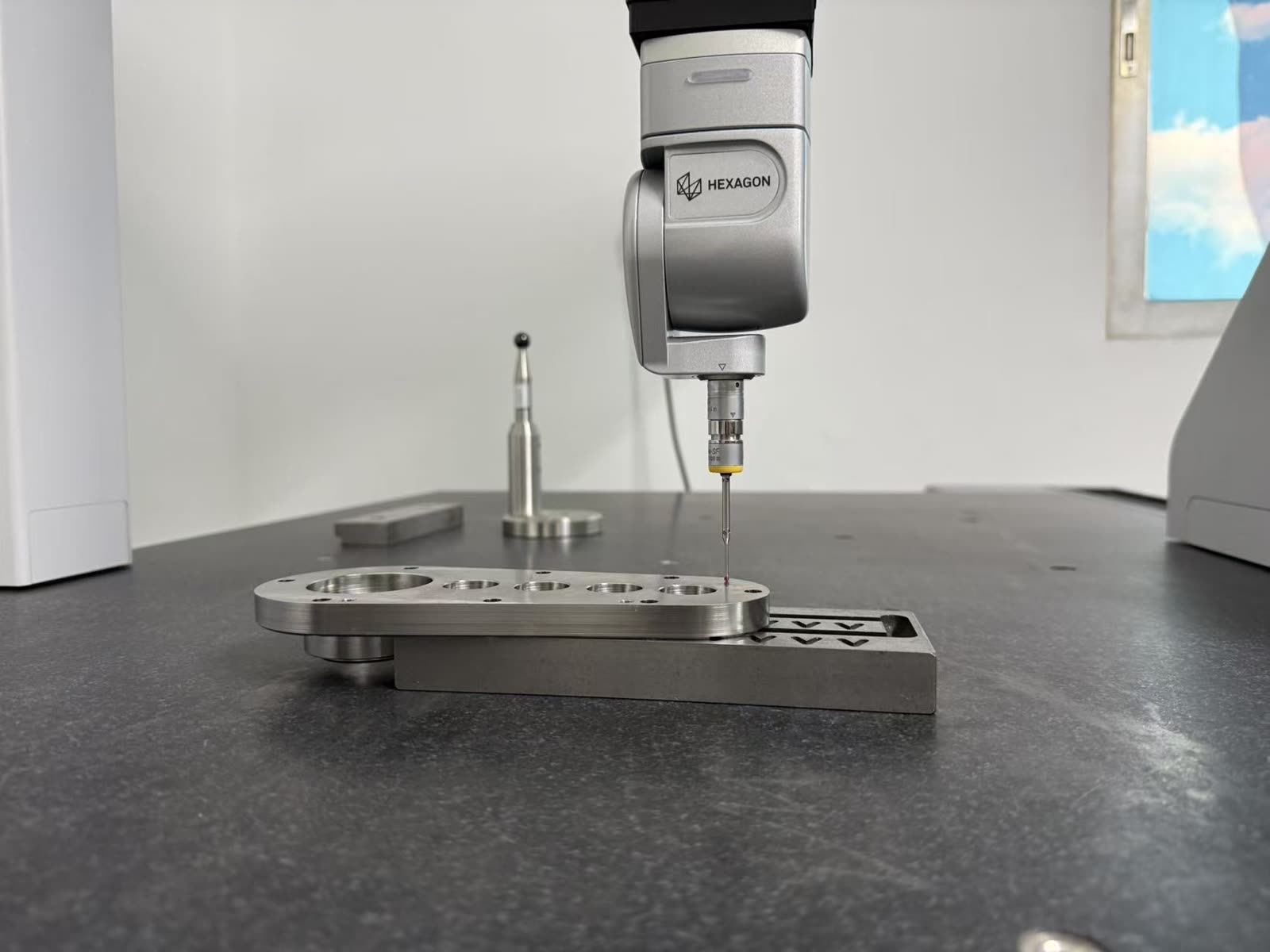
The machinist programs a CMM (Coordinate Measuring Machine) to probe the hole center in multiple locations and fit a best-axis. The CMM software computes the deviation of the actual hole axis from the true (nominal) axis and reports it as a diametral zone value. If the deviation is within the specified zone, the part passes. CMM reports show a "Actual | Nominal | Tolerance | Deviation | Pass/Fail" row for each controlled feature.
Common Mistakes, GD&T true position CNC machining
Using coordinate tolerances for all features: Coordinate tolerances create square zones and are overly restrictive at 45°. True Position is almost always better for holes.
Specifying MMC on every callout: MMC bonus tolerance is beneficial for clearance-fit holes but inappropriate for tight-fit or press-fit bores where the actual size cannot vary without affecting assembly.
Leaving datums ambiguous: If the drawing has three datum labels but the feature control frame only references A and B, the measurement is under-constrained. Always reference all datums needed to fully locate the feature.
Quick Rule of Thumb, GD&T true position CNC machining
For a bolt-circle pattern (4× M6 holes on a 50mm bolt circle), specify True Position ⌀0.3 A|B|C at MMC. This ensures the bolts will always clear the holes while giving the machinist the maximum possible working tolerance. Discuss the specific application with Ginwate CNC, our team reviews GD&T on every drawing before production starts.
Related Ginwate Resources
- Tolerances Reference, achievable tolerances at Ginwate
- Tolerance Calculator, see cost vs tolerance trade-offs
- CMM Quality Inspection
- How to Read an Engineering Drawing, companion article
- Upload your GD&T drawing for a quote
References: ISO 2768 General Tolerances and CNC on Wikipedia.
FAQs about GD&T true position CNC machining
Is GD&T true position CNC machining right for every project?
No. GD&T true position CNC machining fits some jobs better than others. We help you pick the right spec for your part. Tell us your load, heat, and budget, and we will steer you to the best choice. Most clients save money by picking the right grade up front, not the most premium one.
How fast can Ginwate ship GD&T true position CNC machining parts?
For most GD&T true position CNC machining jobs we quote in four hours. Lead time runs five to ten days for prototypes. Production runs land in two to three weeks. Rush jobs ship in 72 hours when stock is on hand. Send your CAD file to start.
What tolerances can you hold for GD&T true position CNC machining?
Most GD&T true position CNC machining parts hold plus or minus 0.02 mm without trouble. Tighter tols are possible with the right fixturing and a final grind pass. We hit ISO 2768-fH on first try for the bulk of jobs. Spec the tols you need, not tighter than that.
Do you offer DFM review for GD&T true position CNC machining?
Yes. Every quote includes a free DFM review by a senior engineer. We flag hard features, costly tols, and cheaper paths. This pays back fast, most parts get five to twenty percent cheaper after the review. No fee for this service.
Key Takeaways on GD&T true position CNC machining
The right plastic or metal pick saves time and money. GD&T true position CNC machining is one piece of the puzzle. Match the spec to the load, heat, and chemicals your part will see. Pick simple geometry where you can. Spec tight tols only where they matter. We are here to help at every step.
Ginwate has shipped GD&T true position CNC machining parts for hundreds of clients. We work with start-ups and Fortune 500 teams. Our shop runs eight CNC mills and four lathes. We hit lead times of five to ten days for most jobs. Quality is checked at every stage. We back our work with a full quality report.
Want to learn more about GD&T true position CNC machining? Browse our other guides above. Or send your part files for a free quote. We will get back to you in four hours.

Written by
Chenny
Senior CNC engineer at Ginwate · 20+ years aerospace & medical machining